
Dual Earner Tables
Dual-Earner Couples with Children: A UK Time Series, 1956–2016 Proportion of couples with children where both parents were in paid work, at four benchmark years
Summary
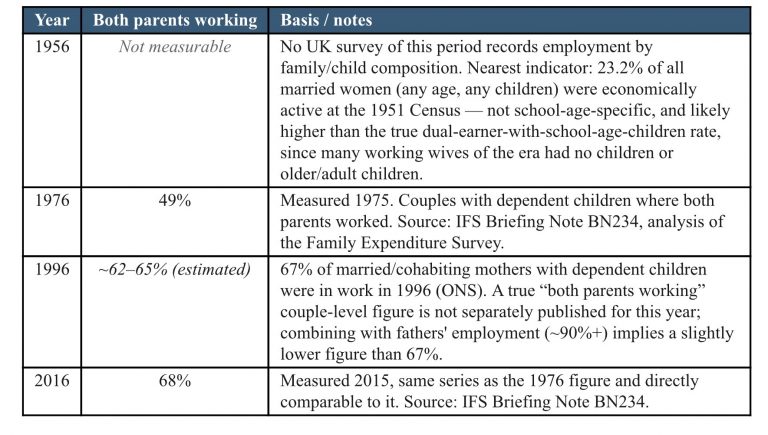
This note brings together the best available UK statistics on the proportion of couples with children where both parents worked, at or near 1956, 1976, 1996 and 2016. A single, continuously-measured official statistic covering this full span does not exist — large-scale household surveys detailed enough to answer this question only begin in the early-to-mid 1970s. The table below therefore combines the closest matching figures from different surveys, with the basis for each figure stated explicitly. Two more recent, precisely-defined ONS figures (2018 and 2021) are included afterwards for additional context.
Additional recent context (ONS, precisely defined)
The ONS “Families and the labour market” series defines this figure precisely — couple families with dependent children (under 16, or 16–18 and in full-time education) where both parents are in employment — using the Labour Force Survey. It only extends back to 1996, so is shown here for the two most recent years available rather than for 2016 itself, where no single narrative bulletin states the figure directly.
-
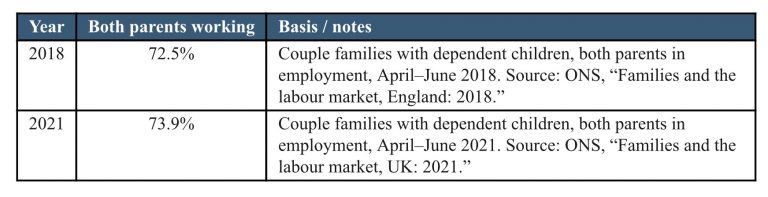
Table 2
Reading the table
● The directly comparable pair is 1976 → 2016 (49% → 68%), both drawn from the same IFS series using the same methodology — this is the strongest evidence in this note for a rising trend.
● The 1996 figure is an informed estimate, not a directly reported “both working” statistic — it is shown in italics in the table to flag this.
● 1956 cannot be stated as a percentage with any real confidence. Including a specific number would overstate what the historical record supports; the surrounding evidence suggests dual-earner households with school-age children were rare at the time, plausibly well under 20%.
● All figures use each survey’s definition of “dependent children” (broadly, under 16, or 16–18 in full-time education), which is close to but not identical to a strict “school age” definition.
● “Both parents working” includes both full-time and part-time employment in every source used here.
Sources
Cribb, J., Costa Dias, M., Joyce, R. and Waters, T. (2018). The rise and rise of women’s employment in the UK. IFS Briefing Note BN234. ifs.org.uk/publications/rise-and-rise-womens-employment-uk
Office for National Statistics (2014). Women in the Labour Market. ons.gov.uk (source of the 1996 married/cohabiting mothers’ employment rate).
Office for National Statistics (2018). Families and the Labour Market, England: 2018. ons.gov.uk
Office for National Statistics (2022). Families and the Labour Market, UK: 2021. ons.gov.uk Census of England and Wales 1951, as cited in Bryson, A. and Joshi, H. (2020). Women’s Employment, Education and Skill in a Changing Labour Market. IZA Discussion Paper No. 13289. docs.iza.org/dp13289.pdf (source of the 1951 married women’s economic activity rate).
Prepared for personal/informal use, not for academic publication. Figures are drawn from secondary analysis of official and academic sources rather than original data extraction; where a source presents an estimate rather than a directly measured statistic, this is flagged in the table.